
The Technology Changed. Human Nature Didn’t.
The Mass Hysteria AntiZionism has Produced

Lately I have found myself thinking about witch hunts of centuries ago. Not the Holocaust, which I think about more than most to be sure. But the witch hunts.
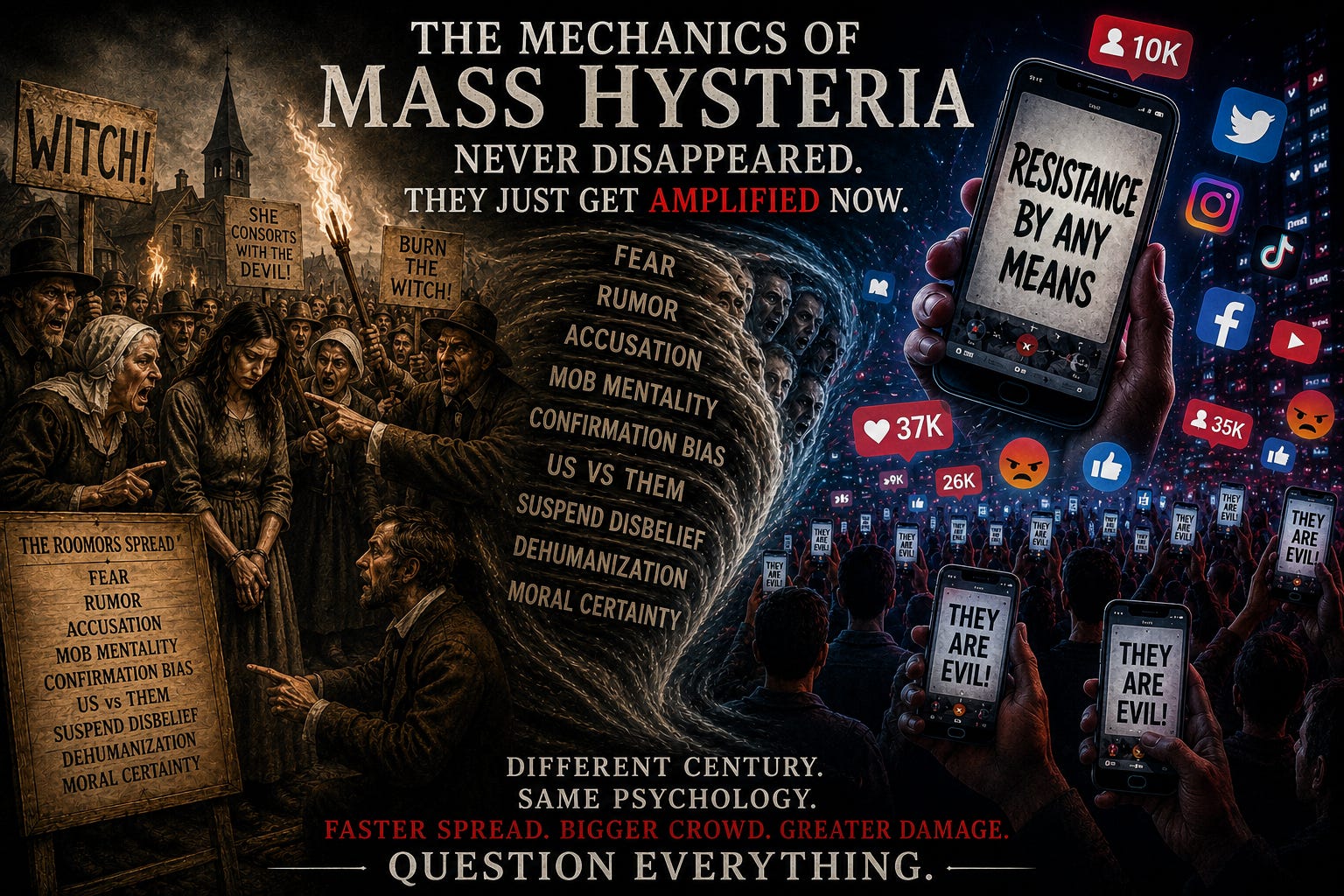
Strange as it sounds, to me they seem like the most useful analogy for understanding some of today’s dynamics.
Not because I believe we are literally reliving Salem or even medieval Europe, but because I keep returning to a troubling question: If mass hysteria was possible then, what happens when the same human instincts collide with social media?
We often comfort ourselves by imagining that people centuries ago were uniquely susceptible to irrational fears. They lacked modern education. They lacked access to information. They lived in a world shaped by rumor, superstition, and limited communication.
But human nature has apparently not changed nearly as much as we would like to believe.
The same species that once became convinced that women were consorting with the devil now spends its days consuming an endless stream of emotionally charged content curated by algorithms designed to maximize engagement.
The technology is new. The human beings and our deeply wired impulses, our unmistakable impressionability buttons, are not.
But the antizionist obsession with Israel is just criticism, right?
“Every nation should be subject to criticism.” That is a line so many of us have felt strangely compelled to repeat again and again — but only when the conversation turns to Israel.
Which is perhaps the first clue that criticism is not really the core issue at all. The issue is fixation. It is the singular focus. It is the raw hate residing inside it all disguised as criticism.
Many of us have spent the past 20 months trying to warn that Israel occupies an outsized space in the public imagination while countless other conflicts, atrocities, and human rights abuses barely register. We point out that people who cannot locate Israel on a map often speak about it with absolute certainty. Meanwhile, accusations spread with astonishing speed and are repeated thousands of times before anyone pauses to ask whether they are true.
During the witch hunts, people became consumed by a narrative. Once enough people accepted it, evidence became secondary. Doubt itself became suspicious. The pressure to conform became stronger than the impulse to question.
The frightening thing about mass hysteria is that it never feels like hysteria to the people caught up in it.
It feels like moral clarity.
If someone is convinced that witches are real and pose an existential threat, extraordinary measures begin to feel justified. If someone is convinced that Israel is uniquely evil, guilty of every imaginable crime, and responsible for the world’s suffering, extraordinary conclusions begin to feel justified there too.
The lie comes first. The moral verdict follows.
And once the moral verdict has been rendered, almost anything can be rationalized in its name.
The participants in Salem believed they were exposing evil. They believed they were standing on the side of righteousness. They believed their cause was so self-evidently just that ordinary skepticism no longer applied.
What concerns me is not simply that these dynamics still exist. It is that we have built machines capable of amplifying them on a scale our ancestors could never have imagined.
A lie once traveled by word of mouth. Then by pamphlet. Then by newspaper.
Now it can reach millions of people before breakfast.
The libels of earlier centuries spread from village to village. They took time, but they traveled and reached their intended audiences. Today’s libels spread around the globe in minutes. They are repeated, reposted, algorithmically amplified, and absorbed by people who often have little knowledge of the history, facts, or context surrounding what they are consuming.
If human beings were capable of contagious hysteria centuries ago, why would we assume we are immune today?
In fact, we may be living through the most efficient delivery system for mass hysteria ever created.
That possibility should concern all of us. Not because the target is always the same, but because the mechanism is.
Human vulnerability to that mechanism is what gets tapped.
The medium is the message...